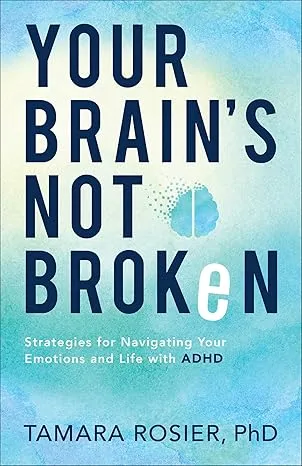
In a landscape where ADHD is often reduced to clinical checklists of inattention and hyperactivity, Dr. Tamara Rosier’s book, Your Brain’s Not Broken: Strategies for Navigating Your Emotions and Life with ADHD, emerges as a compassionate and practical guide for those struggling with the condition. Dr. Rosier, who lives with ADHD herself, seeks to talk directly to the individuals who feel overwhelmed and trapped by self-loathing. Her central message is that an ADHD brain is not incomplete or “wrong”; it is simply wired differently, presenting unique challenges that require a unique set of tools.
 Buy here: https://amzn.to/4qhBM3j
The Overlooked Emotional Core of ADHD
While many discussions of ADHD focus on executive functioning, one of the book’s greatest strengths is its emphasis on ADHD and emotional regulation. Rosier argues that people with ADHD tend to experience the world through an emotional lens first. She explains that the familiar “just do it” button—the part of the prefrontal cortex responsible for task initiation—is often offline in the ADHD brain. As a result, individuals may rely on emotional triggers like urgency, anger, or shame to get moving. By directly addressing the “big emotions” and common “thought traps” ADHDers face, the book offers a clear path toward emotional health and a meaningful reduction in shame. For more on where this emotional wiring comes from, see our review of Gabor Maté’s Scattered, and for the relationship fallout it can cause, see ADHD and Relationships.
Divergent vs. Convergent Thinking
A key insight in the book is the distinction between divergent and convergent thinking.
Divergent Thinking: The ADHD brain’s natural mode—taking a single idea and expanding it into countless interconnected possibilities.
Convergent Thinking: Sequential, deductive thinking (the Sherlock Holmes style), which often feels “insanely boring” to the ADHD mind. Rather than framing divergent thinking as a flaw, Rosier encourages readers to embrace it, while also learning how to gently “trick” themselves into convergent thinking when focus and follow-through are required.
Practical Tools for Growth
Beyond theory, the book provides concrete tools for increasing day-to-day functionality (in the same vein as our own science-backed tools for managing ADHD):
The Solve-It Grid: A 4×4 framework that helps readers break tasks into categories based on enjoyment and emotional intensity, making decisions more actionable.
Personal Metaphors: By identifying a personal metaphor for ADHD—such as running a three-legged race with a version of yourself that lacks a prefrontal cortex—readers can better understand their challenges and design solutions that actually fit.
Parts Work: The book introduces a form of “parts work,” encouraging readers to recognize both their ADHD and non-ADHD selves, allowing these internal parts to communicate, negotiate, and care for one another.
A Compassionate Perspective with Caveats
The book is widely appreciated for offering a nuanced understanding of ADHD as more than a simple attention deficit. It resonates strongly with high-IQ adults who have long felt “out of step” with their peers. That said, some readers may find the occasional religious references unexpected or out of place in an otherwise logic-driven framework. Others note that while the content itself is powerful, the book’s structure can make it harder to quickly extract key ideas—potentially a challenge for readers with more severe ADHD symptoms.
Ultimately, Your Brain’s Not Broken reframes ADHD as a matter of learning to work with a unique brain, not fixing a broken one. It points readers toward a more fulfilling life grounded in self-understanding, empowerment, and self-acceptance.
Rating: ⭐⭐⭐⭐ (4/5)
Buy here: https://amzn.to/4qhBM3j